

The Recording Graveyard
Every recorder ends up with one: A morbid, but fitting name of a phenomenon that has plagued recordists for years.
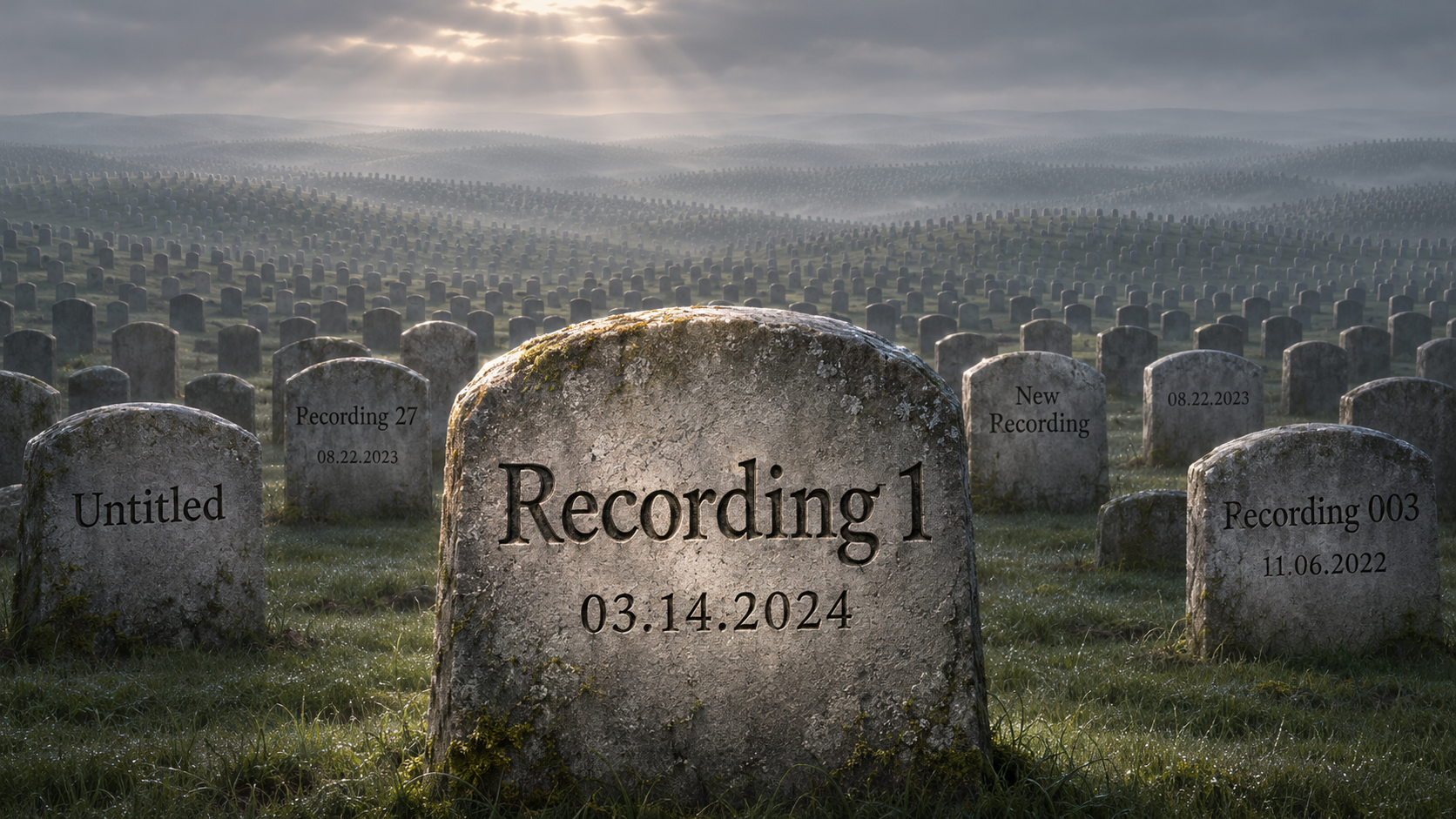
Scroll far enough down any recorder you have used for a while and you will find it. "Recording 27." "Untitled." "New Recording." A date that meant something on the day it was saved, back when you still remembered why. Nothing in it is gone. Every file still plays. But they all look alike now, so you never visit.
That is the recording graveyard, where recordings go to die.
Every one of them had a reason
You pressed record because something was worth keeping. A melody before it slipped away. The first time a high note actually landed. A teacher explaining the one thing you knew you would forget. A voice memo to yourself on the walk home, about an idea you did not want to lose.
The audio stayed. The reason didn't.
For a day or two, the reason lives in your head. Then the next few dozen recordings arrive, and it fades. What's left is a name and a timestamp, the two details that tell you the least.
Same take, different ears
What you hear in a recording isn't what anyone else hears. Your vocal coach hears tension in your jaw. You hear the moment you stopped being scared of the bridge. A stranger hears a unique rendition of a song they like. It's the same file, with three different reasons to keep it.
That is why the graveyard is so hard to fix from the outside. No app, and no algorithm, can know which eight seconds of a forty-minute session were yours. Recordings are personal in a way most files aren't. The only person who can say why one counts is the person who made it.
Why recorders stop at the button
Most recording apps are built around a single action: the press. Capture is the feature. Once the file exists, the app considers its work finished. Everything after that is left to you and a filename.
Filenames were never meant to carry that much. You get a few dozen characters before the text cuts off. Some symbols aren't allowed at all, so "take 3 / bridge / finally!" turns into something you didn't write. There's nowhere to say how you felt, what you'd change next time, or that the good part starts at 2:14.
So you don't write it down. A month later, you can't remember it either.
Recording with intention
VivaTake Recorder starts from a different assumption: a recording becomes useful after you press stop, not when you do.
That means you can attach a personal note to a recording, with room to write why you pressed record, in as many words as it takes. It means pinning a thought to the exact second it belongs to, so "the good part starts at 2:14" lives at 2:14. It means tags and search that follow how you think about your own recordings, instead of how a file system does.
None of it decides for you. It just gives the reason a place to stay.
Record with intention, and the next time you scroll back, you won't be walking through a graveyard. You'll find each reason right where you left it.
Be first to record with VivaTake Recorder
Join the waitlist and we'll email you the moment it lands.
No spam. Just one email when it launches.